I just had one of those magical experiences, that makes you forget that you live in the middle of a big city. For some years I have occasionally heard the sounds of what I thought to be a woodpecker - a resonant drumming sound in short bursts. Living in Brixton, though, I pretty much dismissed it, thinking it must have originated from some other source.
Today it's a warm sunny day, and so I decided to take a short walk to get a bit of air, and try to shake off a slight lingering hangover. As soon as I stepped into the park, I heard that familiar drumming sound. It seemed to be coming from a nearby tree, so I wandered over to investigate. Sure enough, high up on the dead branch of a sycamore tree, was a beautiful woodpecker, not the green kind you see on the side of a can of cider, but one with a red rump, a creamy white breast, and black and white stripes on its head and upper body. A quick search on the web indicates that it's a Great Spotted Woodpecker.
With its large powerful beak it was digging out grubs from the dead branch, in short percussive bursts. I don't know if it noticed me watching it, but within a minute or two it flew away to a lower branch on an adjacent tree. But in 10 minutes or so, when I was on the other side of the park, I heard it again and walked back to watch it's further endeavours.
I have always been fascinated by the boundary between tame and wild. I sometimes wonder what the city would look like in 10 years if it were abandoned. How far would wild crazy nature have encroached upon our seemingly corralled and controlled environment. Perhaps if we look closely, even now, we might see that what we think is a man made, man-centred world, is just a thin veneer on top of the untamed and untenable vast nature.
It gives me a strange kind of joy to find indications of nature's processes going on even in this big city. For a while I took pictures of stalactites and stalagmites forming on great concrete structures such as the London's South Bank Centre, underpasses, and council estates. Along with them I observed small fenced-off areas that had turned into rampant jungles, moss colonies on top of greenhouse roofs, the heave for of paving slabs from the inexorable pushing of tree roots, and the gradual disintegration of my clothing due to the moths that lay their eggs in my clothing drawer.
Sunday, 30 March 2008


Friday, 28 March 2008
The End
Well, not quite, actually. We have finally handed in our software engineering project. most of it, at least. I'm writing this by hand, just for fun. It's not as fast as typing and I haven't found a very comfortable way to work with the computer, but I don't like typing on a laptop either. Anyway, when it was time to hand in the work, Usman and I decided to have a quick look at the game we have created, and to our horror, it didn't work, Usman began to panic, but it was really too late to do much else, So we have to just hope that they test it in Windows, in which it does work.
I'm tired now, as I was up most of the night, editing our final report. Actually, this is quite fun. I'm not having to do much correction, and I am writing as fast as possible, in a cursive script. Pretty damn cool. It's another rainy day here in Mile End. I could easily just curl up under the table and go to sleep. This form of input would be great for texting, actually. But maybe not so easy on a small screen. I think I'm rambling. will stop now.
I'm tired now, as I was up most of the night, editing our final report. Actually, this is quite fun. I'm not having to do much correction, and I am writing as fast as possible, in a cursive script. Pretty damn cool. It's another rainy day here in Mile End. I could easily just curl up under the table and go to sleep. This form of input would be great for texting, actually. But maybe not so easy on a small screen. I think I'm rambling. will stop now.
Sunday, 23 March 2008
Trees do not heal - they just shut off
It's true, actually. Not just a joke. In contrast to animals, who in general heal or renew damaged tissue, trees just shut off, or compartmentalise an area of damage or decay. The detailed mechanisms of this process are only now being studied. The credit for this discovery, or at least for making it explicit, largely goes to Dr. Alex Shigo, who worked for the United States Forest Service. More on him on http://www.shigoandtrees.com.
The main idea is that when damage occurs to a tree, it will react to the damage, creating a number of chemical barriers around the damaged area. These barriers seal off the affected area, which will then rot out. If the barriers do their job effectively, fungal and other agents which cause the rotting will not spread into healthy wood.
I'm not being too specific about the barriers as it's a while since I studied it and I'm by no means an expert. Another thing that I have observed trees to do is to shut branches down. These tend to be the unproductive ones - those that are not photosynthesising a lot. This may be be because they are overshadowed by other branches, or because they are sick or damaged. In any case, their leaves will go brown and the branch will start to rot. The clever bit is that the conical section of branch inside the trunk will be sealed off, so that when the branch actually falls off the tree, it leaves a corresponding conical hole in the tree.
Today I climbed a large plane tree and kicked off a dead branch, and it did exactly that. I also saw a nuthatch scurrying around on another tree. Perhaps the hole I left will become a home for a nuthatch.
The main idea is that when damage occurs to a tree, it will react to the damage, creating a number of chemical barriers around the damaged area. These barriers seal off the affected area, which will then rot out. If the barriers do their job effectively, fungal and other agents which cause the rotting will not spread into healthy wood.
I'm not being too specific about the barriers as it's a while since I studied it and I'm by no means an expert. Another thing that I have observed trees to do is to shut branches down. These tend to be the unproductive ones - those that are not photosynthesising a lot. This may be be because they are overshadowed by other branches, or because they are sick or damaged. In any case, their leaves will go brown and the branch will start to rot. The clever bit is that the conical section of branch inside the trunk will be sealed off, so that when the branch actually falls off the tree, it leaves a corresponding conical hole in the tree.
Today I climbed a large plane tree and kicked off a dead branch, and it did exactly that. I also saw a nuthatch scurrying around on another tree. Perhaps the hole I left will become a home for a nuthatch.
Wednesday, 19 March 2008
Meta bolg
Having a blog is rather like having a camera. When you have a camera, particularly in the first enthusiastic phase, you tend to look at the world and a rather different way. Perhaps I should say "I" do. I will be constantly on the lookout for aesthetic moments – ones that I can capture and take home with me. Rather than simply seeing, and appreciating what I see, I regard what I see as a commodity that can be kept. Of course, a visual replica of what I see does not have the same richness as the original experience: there is no other sensory context for the sight.
As soon as I started to keep a blog, a part of me was always on the lookout for things that I would like to record later. Ideas that occurred to me, interactions with other people, and things that I read and found interesting enough to share with others. Another side of me struggles with this slightly. Rather as with the camera, it leads to a situation where I feel I am not fully partaking of my life.
On the one hand, I very much appreciate having a receptacle for my thoughts. I have always been the kind of person that has a lot of ideas. I rarely take things at face value, but instead churn and process them until I understand or finally give up trying to understand, usually because I have lost interest. If I feel as though I have understood something well, I want to share it with others, so a blog presents me with a great opportunity to do that.
Writing a blog has made me appreciate other's blogs more. People are interesting and there is something about the blog format that allows these qualities to come through. Of course, some blogs are done in a professional or other specialised context, but even then the writers' personality often shows through. And of course the other great thing about blogs is that they are so immediate – one can write about one's experience or understanding immediately.
As soon as I started to keep a blog, a part of me was always on the lookout for things that I would like to record later. Ideas that occurred to me, interactions with other people, and things that I read and found interesting enough to share with others. Another side of me struggles with this slightly. Rather as with the camera, it leads to a situation where I feel I am not fully partaking of my life.
On the one hand, I very much appreciate having a receptacle for my thoughts. I have always been the kind of person that has a lot of ideas. I rarely take things at face value, but instead churn and process them until I understand or finally give up trying to understand, usually because I have lost interest. If I feel as though I have understood something well, I want to share it with others, so a blog presents me with a great opportunity to do that.
Writing a blog has made me appreciate other's blogs more. People are interesting and there is something about the blog format that allows these qualities to come through. Of course, some blogs are done in a professional or other specialised context, but even then the writers' personality often shows through. And of course the other great thing about blogs is that they are so immediate – one can write about one's experience or understanding immediately.
Your baby has been delivered, sir.
I have seen the future. The future is touch. I have to admit, Bill Gates saw this before me, but there are others that have not yet been converted.
She arrived in a pink plastic bag, from which she emerged looking like just another laptop. Plugged in, turned on, started up. Took forever to boot, during which time I took the casing off the bubbly's cork, but left the cork in. And then I saw a beautiful vista. Vista. Windows Vista. It actually is rather pretty, although I'm expecting it to screw up completely any time soon.
She's a Toshiba M700, the latest model of medium priced business tablet pc from them. (See/buy it) And the way she transitions from one mode to the other is quite elegant. The handwriting recognition is surprisingly good - that's a bonus. She, ok, it also has voice recognition and speech to text built in, but i've heard that before - we'll see how good it is. Not to mention fingerprint login, which is great, especially from tablet mode. Ooh, lots to play with. Now, configuration...
She arrived in a pink plastic bag, from which she emerged looking like just another laptop. Plugged in, turned on, started up. Took forever to boot, during which time I took the casing off the bubbly's cork, but left the cork in. And then I saw a beautiful vista. Vista. Windows Vista. It actually is rather pretty, although I'm expecting it to screw up completely any time soon.
She's a Toshiba M700, the latest model of medium priced business tablet pc from them. (See/buy it) And the way she transitions from one mode to the other is quite elegant. The handwriting recognition is surprisingly good - that's a bonus. She, ok, it also has voice recognition and speech to text built in, but i've heard that before - we'll see how good it is. Not to mention fingerprint login, which is great, especially from tablet mode. Ooh, lots to play with. Now, configuration...
Tuesday, 18 March 2008
Why I like computer science
I was at a dinner party the other night, explaining to a group of strangers how the Internet works. Whether out of genuine interest or politeness, they were very encouraging, even when I got onto protocols and layers and packet-switching. Why? Because I explained it in terms that they could understand. Saying 'layman's terms' would be patronising - all I did was use familiar terms and concepts, and luckily they were intelligent people with a lot of common sense. By common sense I mean they had a lot of handles upon which to hand new concepts - they could find similar ideas to the computing ones I was expressing.
And for me the two main points of interest in studying this subject are its relevance and its techniques. Computer science is relevant because we live in the age of computers. We watch films like Terminator, nightmare visions of a world where machines have aquired consciousness and taken over. Consciousness, questionable. No idea whether that's going to happen. But taken over? Already happened, baby. There is nary an area of human activity which is not highly dependant on computers.
As for techniques, the complexity of computers is staggering, with requirements for extremely precise mechanical, electrical and electronic components, run by perhaps even more complex software. The length of computer programs is measured in lines of code. Here is one line:
for (int i = 0; ihttp://www.leshatton.org/Documents/LOC2005.pdf
Windows 2000 contains perhaps 30 million, XP around 40 million. Vista, who knows?
Red Hat Linux 7.1, being open source, allows for direct measurement and contains over 30 m lines of code. http://www.dwheeler.com/sloc/
That represents about 8,000 person years of programming. This is rather a daunting statistic, showing the complexity of things we're starting to take for granted.
So what is it about this that doesn't just trigger snoring for me? What do I actually find fascinating?
(to be continued)
And for me the two main points of interest in studying this subject are its relevance and its techniques. Computer science is relevant because we live in the age of computers. We watch films like Terminator, nightmare visions of a world where machines have aquired consciousness and taken over. Consciousness, questionable. No idea whether that's going to happen. But taken over? Already happened, baby. There is nary an area of human activity which is not highly dependant on computers.
As for techniques, the complexity of computers is staggering, with requirements for extremely precise mechanical, electrical and electronic components, run by perhaps even more complex software. The length of computer programs is measured in lines of code. Here is one line:
for (int i = 0; i
Windows 2000 contains perhaps 30 million, XP around 40 million. Vista, who knows?
Red Hat Linux 7.1, being open source, allows for direct measurement and contains over 30 m lines of code. http://www.dwheeler.com/sloc/
That represents about 8,000 person years of programming. This is rather a daunting statistic, showing the complexity of things we're starting to take for granted.
So what is it about this that doesn't just trigger snoring for me? What do I actually find fascinating?
(to be continued)
IT and Computer Science
I am awaiting delivery of a new laptop. I have had one laptop before, bought for me by a company that I was working for, and at the time, it was cutting edge. But after I hit it, it was never quite the same, so now I only use it for playing movies on, as it has an S-Video output (in other words I can plug it into the TV).
The new one, I think I am justified in saying, is also fairly snazzy. It is what you might call a tablet/laptop hybrid. That means that as well as working and looking the same as a laptop, the screen swivels round and snaps onto the casing, forming it into a tablet. You can then write on the screen with a special pen, or touch it with your finger, or, heaven forbid, some other part of your anatomy.
It has long been a dream of mine to have such a thing, but I only found out by chance that they even existed, while looking online for a laptop. A friend has a tablet, which is great, as it allows you to handwrite notes in lectures, which are then digitally saved, but doesn't have an attached keyboard. With handwriting recognition, of course, writing can be converted into a typed form. But the killer app for me would be annotating lecture slides. Then my notes and the slides would be in one place.
It's due to arrive today, and I'm actually nervous. I bought it online, and the supplier doesn't have a reassuringly smooth order tracking process, so I suppose I'm slightly skeptical that it will actually arrive. I'm going to France in a couple of days and I would be disappointed not to take it, as I need to revise for upcoming exams.
. . . . . . . . . . . . . .
As some of you may know, I'm studying computer science. When I tell people this, one of the more common responses is - "oh, my hard drive doesn't work - do you know why?" or some such IT question. Actually I hate IT: the complexity, the endless acronyms, the corporate people power-dressing a crap product to sell it to clueless small businesses... the sheer stifling boredom of it. I get so turned off by IT publications that it makes me wonder why on earth I would want anything to do with computers.
Stacked on top of that are the horrendous user interfaces of some computer programs, which make them extremely frustrating to use. How many people have been insulted by a message that pops up saying something like "Illegal memory request in module 111073 - this program will now terminate"? Or not been able to make progress with a program because against all rules of common sense they have hidden a common function in an obscure place.
Well, those things *are* improving, partly because people on computer science degrees are being taught how to design interfaces better. It's quite a challenging thing to do, I am finding. For my third year project, I'm considering doing some kind of user interface project. I'll say more about that later, I'm sure.
Next article will be a continuation of this - why I *do* like computer science.
The new one, I think I am justified in saying, is also fairly snazzy. It is what you might call a tablet/laptop hybrid. That means that as well as working and looking the same as a laptop, the screen swivels round and snaps onto the casing, forming it into a tablet. You can then write on the screen with a special pen, or touch it with your finger, or, heaven forbid, some other part of your anatomy.
It has long been a dream of mine to have such a thing, but I only found out by chance that they even existed, while looking online for a laptop. A friend has a tablet, which is great, as it allows you to handwrite notes in lectures, which are then digitally saved, but doesn't have an attached keyboard. With handwriting recognition, of course, writing can be converted into a typed form. But the killer app for me would be annotating lecture slides. Then my notes and the slides would be in one place.
It's due to arrive today, and I'm actually nervous. I bought it online, and the supplier doesn't have a reassuringly smooth order tracking process, so I suppose I'm slightly skeptical that it will actually arrive. I'm going to France in a couple of days and I would be disappointed not to take it, as I need to revise for upcoming exams.
. . . . . . . . . . . . . .
As some of you may know, I'm studying computer science. When I tell people this, one of the more common responses is - "oh, my hard drive doesn't work - do you know why?" or some such IT question. Actually I hate IT: the complexity, the endless acronyms, the corporate people power-dressing a crap product to sell it to clueless small businesses... the sheer stifling boredom of it. I get so turned off by IT publications that it makes me wonder why on earth I would want anything to do with computers.
Stacked on top of that are the horrendous user interfaces of some computer programs, which make them extremely frustrating to use. How many people have been insulted by a message that pops up saying something like "Illegal memory request in module 111073 - this program will now terminate"? Or not been able to make progress with a program because against all rules of common sense they have hidden a common function in an obscure place.
Well, those things *are* improving, partly because people on computer science degrees are being taught how to design interfaces better. It's quite a challenging thing to do, I am finding. For my third year project, I'm considering doing some kind of user interface project. I'll say more about that later, I'm sure.
Next article will be a continuation of this - why I *do* like computer science.
Wednesday, 12 March 2008
Car purples
If I had a car, the title of this piece would be "Car Blues". But I don't, so I have chosen a much more cheerful colour. I recently disposed of my car: its lengthy period of decline was followed by an acute attack of spilling its steering fluid all over the road in a most unseemly way. I decided that enough was enough, and had it towed away. At no cost to myself, I was pleased to find out.
I was worried to be losing my car, as I used it a lot. Against all environmental friendliness, I particularly appreciated being able to use it for short distances. It meant I could just jump in without consulting timetables or considering the weather, and after a relatively short time, be at my destination. I found it amusing that some parents were so right on that they kidded themselves that it was just as easy to get around with kids on public transport as in a car.
But I did not find it a difficult transition, actually. My journeys may now involve a bit more planning, but I still arrive at my destination in a reasonable time, on the whole. And I already had an Oyster card, so it isn't costing any extra for as many local journeys as I want.
After a few months of car-free living, somebody asked me if I was missing my car. "Not at all," I answered, "I am much less stressed without it." They wondered what was stressful about a car, and we were both surprised by the length of the list of things that I came up with. I will attempt to reproduce it here.
Money. Cars cost a lot
Safety - especially with an older car, you get worried every time you hear a new noise on the car. And in the end one of the noises is sure to be the terminal one!
Security - I had my car broken into once - all for a few pound coins I had left out. After that, every time I heard a noise on the street, I assumed the worst.
Road Rage - mine and others'. Traffic in the UK is generally diabolical. London can be a particularly frustrating place. Why does everyone travel at the same time? Oh, no, it's that busy all the time.
You can't really do much else when you're driving, and it requires some concentration. In contrast, on public transport the control is out of your hands, you can sit back (if you can get a seat..) and read or look around.
There might have been others, I was on a bit of a roll. But that will suffice. And I haven't had too many problems with trains and tubes, either... I recommend taking the plunge.
I was worried to be losing my car, as I used it a lot. Against all environmental friendliness, I particularly appreciated being able to use it for short distances. It meant I could just jump in without consulting timetables or considering the weather, and after a relatively short time, be at my destination. I found it amusing that some parents were so right on that they kidded themselves that it was just as easy to get around with kids on public transport as in a car.
But I did not find it a difficult transition, actually. My journeys may now involve a bit more planning, but I still arrive at my destination in a reasonable time, on the whole. And I already had an Oyster card, so it isn't costing any extra for as many local journeys as I want.
After a few months of car-free living, somebody asked me if I was missing my car. "Not at all," I answered, "I am much less stressed without it." They wondered what was stressful about a car, and we were both surprised by the length of the list of things that I came up with. I will attempt to reproduce it here.
Money. Cars cost a lot
- for maintenance - especially as they get older
- for fuel
- for Tax
- for insurance
- for parking permit
Safety - especially with an older car, you get worried every time you hear a new noise on the car. And in the end one of the noises is sure to be the terminal one!
Security - I had my car broken into once - all for a few pound coins I had left out. After that, every time I heard a noise on the street, I assumed the worst.
Road Rage - mine and others'. Traffic in the UK is generally diabolical. London can be a particularly frustrating place. Why does everyone travel at the same time? Oh, no, it's that busy all the time.
You can't really do much else when you're driving, and it requires some concentration. In contrast, on public transport the control is out of your hands, you can sit back (if you can get a seat..) and read or look around.
There might have been others, I was on a bit of a roll. But that will suffice. And I haven't had too many problems with trains and tubes, either... I recommend taking the plunge.
Friday, 7 March 2008
Pelicans crossing
So, to continue the theme of blind people and road crossings, one of the things that my lecturer mentioned was that the push boxes at Pelican crossings, where you push a button to indicate that you wish to cross, have haptic 'displays' to supplement the visual and audible ones. Haptics is to do with touch, and what the displays consist of is a metal cone that rotates when it is safe to cross.
Yesterday I was looking for them, but all I could see was two yellow things that protrude underneath the box. I had the impression one of them was rotating, but I think, in retrospect that this was a hallucination. This evening, the sharp eyes of my daughter, Ruby, which are mounted a little lower than mine, found the rotating thing itself. She agreed that it was very cool.
What amazed me yesterday was that I had never before seen the former protuberances, which, while they are not huge, are not insignificant either. You will, I'm sure, notice them yourself now if you hadn't before. Having no idea that they were there, I had never seen them. It's possible, of course, that they are a new thing, but scarcely possible that they have changed or adapted every crossing button box within the last few days.
What it illustrates to me is that we actually build our worlds depending on what we expect to see. I don't mean that the thingies did not exist at all before I knew to look for them, but at least that they did not exist to me. So I didn't see them. This is not revolutionary thinking. From my layman's reading on the matter, it seems to be well accepted in cognitive science circles that we paste together brief and fragmentary perceptions into a seamless experience. In other words, the process of consciousness (for want of a better phrase) is a constructive one. We continually build our reality.
Ruby also continually builds her reality, and I think hers is quite different to mine, although luckily we share enjoyment in a lot of the same things, such as sushi, rock-climbing and practical jokes. I am often surprised at how intelligent she is (I asked her tonight whether she thought animals had language and she said 'yes' and I said how do they talk? "In movement" was her precocious and thought-provoking answer. She also made the throwaway comment "and rhinos think in smell" which blew me away!) But perceptually, she will often miss something that is right in front of her, leading typically to my impatience and, I suppose, mildly irritated thoughts along the lines of "come on, open your eyes, you're not even trying to even see it." I will pause at this point in the future and ask myself whether it's possible that it's a 'glue' issue, that her memory or conceptual experience just doesn't have enough in it to construct the world in a way that would include certain things. Sorry if that's a bit abstract.
Yesterday I was looking for them, but all I could see was two yellow things that protrude underneath the box. I had the impression one of them was rotating, but I think, in retrospect that this was a hallucination. This evening, the sharp eyes of my daughter, Ruby, which are mounted a little lower than mine, found the rotating thing itself. She agreed that it was very cool.
What amazed me yesterday was that I had never before seen the former protuberances, which, while they are not huge, are not insignificant either. You will, I'm sure, notice them yourself now if you hadn't before. Having no idea that they were there, I had never seen them. It's possible, of course, that they are a new thing, but scarcely possible that they have changed or adapted every crossing button box within the last few days.
What it illustrates to me is that we actually build our worlds depending on what we expect to see. I don't mean that the thingies did not exist at all before I knew to look for them, but at least that they did not exist to me. So I didn't see them. This is not revolutionary thinking. From my layman's reading on the matter, it seems to be well accepted in cognitive science circles that we paste together brief and fragmentary perceptions into a seamless experience. In other words, the process of consciousness (for want of a better phrase) is a constructive one. We continually build our reality.
Ruby also continually builds her reality, and I think hers is quite different to mine, although luckily we share enjoyment in a lot of the same things, such as sushi, rock-climbing and practical jokes. I am often surprised at how intelligent she is (I asked her tonight whether she thought animals had language and she said 'yes' and I said how do they talk? "In movement" was her precocious and thought-provoking answer. She also made the throwaway comment "and rhinos think in smell" which blew me away!) But perceptually, she will often miss something that is right in front of her, leading typically to my impatience and, I suppose, mildly irritated thoughts along the lines of "come on, open your eyes, you're not even trying to even see it." I will pause at this point in the future and ask myself whether it's possible that it's a 'glue' issue, that her memory or conceptual experience just doesn't have enough in it to construct the world in a way that would include certain things. Sorry if that's a bit abstract.
Let me give a more concrete and easy example of the power of the brain to piece together incomplete data. Most people are aware that they have a blind-spot, an area on the retina which cannot receive visual information. It's due to the way that the optic nerve enters the eye, and would be a poor design, if someone had designed it, because it's quite close to the focal point. If you've not tested this before, try this. What's particularly interesting is that you don't 'see' a hole in your perception; there is no discontinuity. If the background colour is green, from which you 'lose' an object, you see an expanse of green, if it's yellow, yellow. If you don't believe me, try another example.
To give a more dynamic example of this, see this revolving dancer. She's sort of like the hollow mask experiment. Both are examples of sophisticated optical illusions. Actually optical illusions is not an accurate description of them; they are examples of where our sensory processes make assumptions, based on what they expect. I don't know whether this is learned or innate. I suspect it's largely hardwired into the optical processing areas of the brain, which are pretty large, it seems. The Buddhists, who have been studying human consciousness for thousands of years, and keeping records of their observations, separate seeing into the organ of sight (the eye, of course), visual consciousness and the space in which this happens. I don't really know what the latter refers to, but I think it's a tantalising glimpse of a potential area of scientific discovery.
To give a more dynamic example of this, see this revolving dancer. She's sort of like the hollow mask experiment. Both are examples of sophisticated optical illusions. Actually optical illusions is not an accurate description of them; they are examples of where our sensory processes make assumptions, based on what they expect. I don't know whether this is learned or innate. I suspect it's largely hardwired into the optical processing areas of the brain, which are pretty large, it seems. The Buddhists, who have been studying human consciousness for thousands of years, and keeping records of their observations, separate seeing into the organ of sight (the eye, of course), visual consciousness and the space in which this happens. I don't really know what the latter refers to, but I think it's a tantalising glimpse of a potential area of scientific discovery.
Wednesday, 5 March 2008
Cristian Mauls Lyon
This was the backpage headline in one of the tabloids this morning, after Cristiano Ronaldo scored a goal for Manchester United, beating Lyons in the process. Took me a while to get it. Class.
Jasper has left the building!
I released Jasper this morning, as I was myself leaving for college. Last night's stunt (he escaped for several hours) proves that he wanted out , and it was a beautiful warm morning, so I unceremoniously dumped him onto a secluded bit of concrete in the sun. I didn't film the occasion, as my video camera is out of tape. I hope he finds adventure and happiness.
Crossings and coincidences
As I was walking to the tube this morning, I saw a blind man waiting at a crossing. The little green man was indicating that it was safe to cross the road, but there was no auditory signal. Without really thinking, I stopped and said to him "It's green. Would you like a hand across?" Before I even finished speaking he was off, mumbling, "No, I can manage." Luckily the approaching cyclist was not so near that he presented a danger, so I walked on. But it made me think, What if he'd stepped into the path of an oncoming vehicle? How would the good samaritan have felt then? Are the blind man's other senses so sharp that he can tell the road is clear? In which case, why have audio signals at all?
So many questions, so little time...
Ok, so get this. My Graphical User Interfaces lecture this morning was taught by a blind man! Not only that, he talked at some length about traffic crossings. The topic was adding audio to interfaces. It was a fascinating lecture, not only for the content, but also to see how a totally blind person does things that sighted people take for granted.
He was holding a piece of paper to his chest throughout most of the lecture. I wondered what it was for a while, then had a "Doh!" moment, realising it was his notes in Braille form. I hadn't even seen his fingers moving across it. At one point his computer started talking loudly, at an accelerated speed. He quickly turned down the volume on the control panel on the desk, almost as dextrously as he would if he could see it. As an aside, there is precious little audio labelling in the world. I don't think there is any kind of speaker on the panel that would enable one to find the volume knob quickly.
Later on he demonstrated some 'earcons'. These are like icons, but not for your eyes! (Of course). His computer started jabbering again. He said "in between you'll hear some talking; that's just my screen-reader." Again I had failed to spot the blindingly (sorry) obvious. I had been wondering whether his computer keys were Brailled, forgetting that his screen was fairly useless to him. Anyway, the earcons in question were sounds, 2-3 seconds in length, that represented fairground rides. The ride type is mapped to a particular instrument, the ride intensity to the pitch, and the price to the number of notes. Something like that. So a scary rollercoaster might be represented by a rapid highpitched phrase on a piano, a carousel by a couple of low notes on a cello.
I mentioned my ideas to him about different computer input devices that don't use a text-based paradigm. Again I was referred to another member of staff. As it was the same recommended to me before, I'm less of the opinion that I was being fobbed off, and thinking more that I should make contact with the person recommended. Perhaps I'll do that now...
So many questions, so little time...
Ok, so get this. My Graphical User Interfaces lecture this morning was taught by a blind man! Not only that, he talked at some length about traffic crossings. The topic was adding audio to interfaces. It was a fascinating lecture, not only for the content, but also to see how a totally blind person does things that sighted people take for granted.
He was holding a piece of paper to his chest throughout most of the lecture. I wondered what it was for a while, then had a "Doh!" moment, realising it was his notes in Braille form. I hadn't even seen his fingers moving across it. At one point his computer started talking loudly, at an accelerated speed. He quickly turned down the volume on the control panel on the desk, almost as dextrously as he would if he could see it. As an aside, there is precious little audio labelling in the world. I don't think there is any kind of speaker on the panel that would enable one to find the volume knob quickly.
Later on he demonstrated some 'earcons'. These are like icons, but not for your eyes! (Of course). His computer started jabbering again. He said "in between you'll hear some talking; that's just my screen-reader." Again I had failed to spot the blindingly (sorry) obvious. I had been wondering whether his computer keys were Brailled, forgetting that his screen was fairly useless to him. Anyway, the earcons in question were sounds, 2-3 seconds in length, that represented fairground rides. The ride type is mapped to a particular instrument, the ride intensity to the pitch, and the price to the number of notes. Something like that. So a scary rollercoaster might be represented by a rapid highpitched phrase on a piano, a carousel by a couple of low notes on a cello.
I mentioned my ideas to him about different computer input devices that don't use a text-based paradigm. Again I was referred to another member of staff. As it was the same recommended to me before, I'm less of the opinion that I was being fobbed off, and thinking more that I should make contact with the person recommended. Perhaps I'll do that now...
Tuesday, 4 March 2008
Jasper has escaped!
Jasper was looking very forlorn, with drooping antennae and seemingly no energy, so I left the lid of his jar open so he could breathe some fresher air. He seemed barely able to to move, but it was a ploy! When my back was turned he somehow flew out, and buzzed up into the lampshade. Now he has disappeared. I'm a bit scared.
I love desire paths
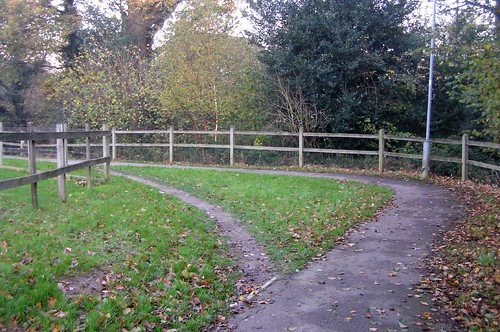
I just walked across a desire path. I do almost every day, in fact, unless it's been raining heavily. A desire path is a path that has been worn into existence because people have chosen that route rather than the made paths. Typically they are shortcuts. My desire path goes diagonally across the small park opposite my house. It is much more direct than the circular path that was put down by the council when they converted a bunch of houses and gardens into the park.
This is not the desire path in my park, but one in Greenwich Park

 When I moved here, ten years ago now, the path led out of the park through a ragged hole in the brick wall across from my house. Either the wall had been gradually worn away by people climbing over it, or someone's desire for a direct route was so strong that they used a sledgehammer. This is how it remains for some years. Then a short but dramatic episode changed the wall and the status of the desire trail forever.
I was in bed one night and was awakened by a wildly revving engine followed by several loud crashes and then a huge crunching noise. I jumped out of bed and ran to the window. A car had smashed into the wall, adjacent to the hole, so there was now a much bigger hole, with a wrecked car in it. On the way, it had wrecked at least one another car. As I watched a couple of people jumped out of the car and legged it across the park. Joyriders.
The wall remained in this sorry state for several weeks, I seem to remember, although the car was taken away pretty fast. And then one day a bricklayer showed up. A weatherbeaten solitary little man, who spent some days fixing the wall. I thought he would simply join up the two broken ends, to reform the original wall. But no, he build two end posts, leaving a comfortable gap framing the end of the desire path. So I think it now has "recognised desire path" status.
I suspect many of our roads went through the process of transition from desire path to a few made bits, to cobbled, to multilane highways with super-smooth Tarmacadam. And that's a great word to finish on.
Tarmacadam.
Here are some pictures of desire paths: http://www.flickr.com/groups/desire_paths/
This is a particularly funny one.
Tarmacadam
This is not the desire path in my park, but one in Greenwich Park
When I moved here, ten years ago now, the path led out of the park through a ragged hole in the brick wall across from my house. Either the wall had been gradually worn away by people climbing over it, or someone's desire for a direct route was so strong that they used a sledgehammer. This is how it remains for some years. Then a short but dramatic episode changed the wall and the status of the desire trail forever.I was in bed one night and was awakened by a wildly revving engine followed by several loud crashes and then a huge crunching noise. I jumped out of bed and ran to the window. A car had smashed into the wall, adjacent to the hole, so there was now a much bigger hole, with a wrecked car in it. On the way, it had wrecked at least one another car. As I watched a couple of people jumped out of the car and legged it across the park. Joyriders.
The wall remained in this sorry state for several weeks, I seem to remember, although the car was taken away pretty fast. And then one day a bricklayer showed up. A weatherbeaten solitary little man, who spent some days fixing the wall. I thought he would simply join up the two broken ends, to reform the original wall. But no, he build two end posts, leaving a comfortable gap framing the end of the desire path. So I think it now has "recognised desire path" status.
I suspect many of our roads went through the process of transition from desire path to a few made bits, to cobbled, to multilane highways with super-smooth Tarmacadam. And that's a great word to finish on.
Tarmacadam.
Here are some pictures of desire paths: http://www.flickr.com/groups/desire_paths/
This is a particularly funny one.
Tarmacadam
Sunday, 2 March 2008
Plane and Simple
If, like me, you take a modicum of interest in the way that the physical world works, then the inclined plane is one of your base units of knowledge, or should be. If you don't think that you are interested in such things, or the terminology puts you off, please read on for a bit, and allow yourself to be surprised. I find it hard to learn java, a programming language, because when I start to look for a definition for one term, I find it usually leads me to several more terms that I don't understand, so then I have to find the meaning of them and process that... and so on. But somewhere in that process I usually find myself in territory I understand and things start to link together: I understand something new.
My point is simply that terminology itself can often be a little frightening. "Inclined plane" sounds a bit alien and abstract. "Knife" or even "Blade" is much more familiar. Indeed, a knife is a very good example of an inclined plane. Any edge tool is. The point of using an abstract term is that it applies to all devices that use a common technique, not just specific ones. In other words, there are many items that we use that contain or are in themselves inclined planes that are not knives, and might not be thought of as blades either.
So what is an inclined plane, and why is it useful? The simplest example is a hill. It is easier for you to get to the top of the hill by walking up the gentle slope, rather than to take the most direct route, up the sheer cliff face. This is intuitive and obvious to us: from the memories we have we can almost feel the effort involved in taking certain routes before we take them.
So, anyway, that's the idea behind an inclined plane. You don't do any less work by walking up the slope than you would be scaling the cliff, but the work that you do is far easier. (Thank you to David Macaulay for his wonderful book, The Way Things Works, where demonstrates this point by drawing primitive people pushing boulders up a ramp, to drop onto the heads of mammoths, in order to stun and hence capture them.) Naturally, the steeper the slope, the harder work it is. Wheelchair ramps are ideally built at an angle of about 5 degrees, meaning 12 foot of ramp for every foot gained in height: a lot of ramp!
Another example. The wedge. Typically used for holding doors open, splitting logs or raising a heavy object off the ground, a wedge is a beautifully simple device. It is really no more than a portable ramp. Rather than push the object to be lifted onto the ramp, you push the ramp under the object. In the case of splitting, of course, we are not lifting anything off the ground. But we could look at the process of splitting a log as lifting one section of the log away from another part. The two billets of wood are glued together by lignin, so it's chemical rather than gravitational forces we are acting against, but the principle is the same.
You will notice that the work done in splitting involves hitting the wedge, edge on, towards the wood, while the work that that wedge is doing, pushing the two pieces apart, is perpendicular (square) to that. So the wedge is not only magnifying the force applied, it is changing it's direction. In this case the long downward movement of the sledgehammer that strikes the wedge is converted into a very powerful sideways force. If you look at splitting wedges, you will see that they are much steeper in angle than wedges for simply holding something open, so that they split the wood more quickly, but of course need more effort to drive in.
So what other things in our world depend on the same principles? Screws, for one, which are shafts with an inclined plane spiraling around the side. You typically turn the screw several times to drive it a short way into the wood. The number of times the thread is wrapped around the shaft governs it's angle, how quickly it will drive into the wood and thus how much effort is required to turn it. Is that the only use of a screw? No, a screw is also used to power a ship. The shape might have evolved due to experimentation, and the peculiarities of fluids (apparently the modern ship's propeller was invented by accident, when a more conventionally shaped screw broke and the boat moved faster!), but essentially a ship's propeller is a screw that turns, driving the boat into the water. In fact the blades of propellers are aerofoils, which are more complex than simple inclined planes, but share important characteristics.
Any mechanical cutting machine works on the principle of the inclined plane. So without the inclined plane, chances are that the Amazon forest would be a lot larger, and in fact that most of England would be forested too! And people would be a lot furrier, although I suppose wax might have been invented. We would be very hampered in our attempts to get around quickly. Zips, cylinder locks, ploughs and a zillion other items we take for granted could not exist. So thank you to Mr. Inclined, the inventor of the inclined plane. I'm off to cut some bread for breakfast.
My point is simply that terminology itself can often be a little frightening. "Inclined plane" sounds a bit alien and abstract. "Knife" or even "Blade" is much more familiar. Indeed, a knife is a very good example of an inclined plane. Any edge tool is. The point of using an abstract term is that it applies to all devices that use a common technique, not just specific ones. In other words, there are many items that we use that contain or are in themselves inclined planes that are not knives, and might not be thought of as blades either.
So what is an inclined plane, and why is it useful? The simplest example is a hill. It is easier for you to get to the top of the hill by walking up the gentle slope, rather than to take the most direct route, up the sheer cliff face. This is intuitive and obvious to us: from the memories we have we can almost feel the effort involved in taking certain routes before we take them.
So, anyway, that's the idea behind an inclined plane. You don't do any less work by walking up the slope than you would be scaling the cliff, but the work that you do is far easier. (Thank you to David Macaulay for his wonderful book, The Way Things Works, where demonstrates this point by drawing primitive people pushing boulders up a ramp, to drop onto the heads of mammoths, in order to stun and hence capture them.) Naturally, the steeper the slope, the harder work it is. Wheelchair ramps are ideally built at an angle of about 5 degrees, meaning 12 foot of ramp for every foot gained in height: a lot of ramp!
Another example. The wedge. Typically used for holding doors open, splitting logs or raising a heavy object off the ground, a wedge is a beautifully simple device. It is really no more than a portable ramp. Rather than push the object to be lifted onto the ramp, you push the ramp under the object. In the case of splitting, of course, we are not lifting anything off the ground. But we could look at the process of splitting a log as lifting one section of the log away from another part. The two billets of wood are glued together by lignin, so it's chemical rather than gravitational forces we are acting against, but the principle is the same.
You will notice that the work done in splitting involves hitting the wedge, edge on, towards the wood, while the work that that wedge is doing, pushing the two pieces apart, is perpendicular (square) to that. So the wedge is not only magnifying the force applied, it is changing it's direction. In this case the long downward movement of the sledgehammer that strikes the wedge is converted into a very powerful sideways force. If you look at splitting wedges, you will see that they are much steeper in angle than wedges for simply holding something open, so that they split the wood more quickly, but of course need more effort to drive in.
So what other things in our world depend on the same principles? Screws, for one, which are shafts with an inclined plane spiraling around the side. You typically turn the screw several times to drive it a short way into the wood. The number of times the thread is wrapped around the shaft governs it's angle, how quickly it will drive into the wood and thus how much effort is required to turn it. Is that the only use of a screw? No, a screw is also used to power a ship. The shape might have evolved due to experimentation, and the peculiarities of fluids (apparently the modern ship's propeller was invented by accident, when a more conventionally shaped screw broke and the boat moved faster!), but essentially a ship's propeller is a screw that turns, driving the boat into the water. In fact the blades of propellers are aerofoils, which are more complex than simple inclined planes, but share important characteristics.
Any mechanical cutting machine works on the principle of the inclined plane. So without the inclined plane, chances are that the Amazon forest would be a lot larger, and in fact that most of England would be forested too! And people would be a lot furrier, although I suppose wax might have been invented. We would be very hampered in our attempts to get around quickly. Zips, cylinder locks, ploughs and a zillion other items we take for granted could not exist. So thank you to Mr. Inclined, the inventor of the inclined plane. I'm off to cut some bread for breakfast.
Saturday, 1 March 2008
My Friend Jasper
I have a pet wasp. Let me remind you that I live far in the Northern hemisphere, and that, until yesterday, it was February. But still, a wasp appeared on my Aloe Vera plant while I was meditating. Well, I say it appeared - it appeared to me. It may have been on the plant for some time already. Something seemed out of the ordinary in my peripheral vision, so a looked directly at the plant and leaned forward slightly. It still took a few seconds for the blob to shape itself into an insect and still longer for me to realise that it was an ordinary wasp - a yellowjacket as they're called Stateside.
But this is by far an ordinary time for a wasp to be sitting on one's Aloe Vera. I left it there, rather than chuck it out into the cold. Last night, as I was drinking a glass of wine, sitting near the aforementioned plant, my fiddling hand behind my back picked up a small light object. I wondered what it was, and my speculation did not extend to wasps, so I was not alarmed. After a few moment of holding the thing I raised my hand to my face to check. Arg! It's a wasp! I flicked it onto the floor. Then I decided I didn't really want a sleepy insect with a nasty sting crawling around my house, so I captured it and put it into a large preserve jar. I added a broken grape, which it soon attached itself too, though whether as food or potential friend, I am unsure.
I wonder what is the longest anybody has kept wasps in captivity. As someone who killed hundreds of wasps with great relish as a child, I feel obliged to look after this one. I read that they like protein-rich foods at Spring-time, so I'll visit the butcher and ask for "one gram of your finest fillet steak". Nothing but the best for my new friend.
But this is by far an ordinary time for a wasp to be sitting on one's Aloe Vera. I left it there, rather than chuck it out into the cold. Last night, as I was drinking a glass of wine, sitting near the aforementioned plant, my fiddling hand behind my back picked up a small light object. I wondered what it was, and my speculation did not extend to wasps, so I was not alarmed. After a few moment of holding the thing I raised my hand to my face to check. Arg! It's a wasp! I flicked it onto the floor. Then I decided I didn't really want a sleepy insect with a nasty sting crawling around my house, so I captured it and put it into a large preserve jar. I added a broken grape, which it soon attached itself too, though whether as food or potential friend, I am unsure.
I wonder what is the longest anybody has kept wasps in captivity. As someone who killed hundreds of wasps with great relish as a child, I feel obliged to look after this one. I read that they like protein-rich foods at Spring-time, so I'll visit the butcher and ask for "one gram of your finest fillet steak". Nothing but the best for my new friend.
Subscribe to:
Comments (Atom)